2026 Years Logo: A Time-Infused Design Asset for Modern Print-on-Demand Creators
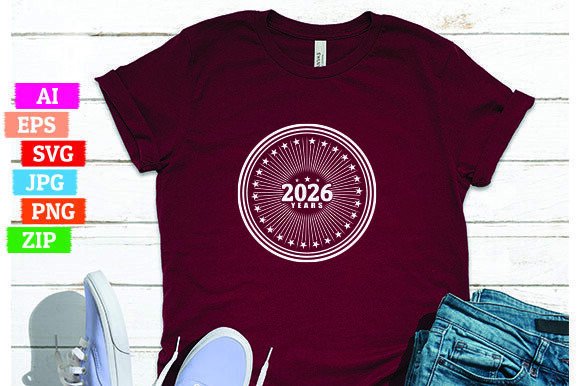
Designs that bridge historical resonance with contemporary visual language are increasingly in demand—especially in the print-on-demand (POD) ecosystem, where differentiation hinges on both conceptual depth and technical readiness. The 2026 Years Logo exemplifies this convergence: a deliberately crafted emblem that evokes chronology, legacy, and forward-looking identity—not as a literal countdown, but as a symbolic anchor point across disciplines. Its value extends far beyond aesthetics; it functions as a modular, production-ready asset engineered for versatility, scalability, and cross-platform fidelity.
Why Chronological Symbolism Resonates Across Audiences
Numbers like “2026” carry layered meaning. To educators, they suggest curriculum milestones or academic year markers; to researchers, they may denote projected data horizons or longitudinal study endpoints; to business owners, they signal strategic planning cycles or product roadmap targets. The 2026 Years Logo leverages this universality without prescribing interpretation—it invites contextual framing rather than enforcing narrative. Unlike date-specific promotional graphics (e.g., “2026 Sale!”), this design avoids temporal obsolescence by treating the number not as a deadline, but as a stable, stylized glyph. Its typography balances geometric precision with subtle organic weight shifts—creating visual tension that feels intentional, not arbitrary.
This neutrality makes it unusually adaptable. A historian might pair it with archival textures for a lecture series poster; a yoga studio could integrate it into a “2026 Years of Mindful Practice” campaign; a tech startup might use it abstractly in a brand evolution timeline. The core strength lies in its semantic openness—its meaning is co-created by the user, not imposed by the designer.
Technical Readiness: Formats That Match Real-World Production Needs
For POD entrepreneurs and freelance designers, file compatibility isn’t optional—it’s operational infrastructure. The 2026 Years Logo delivers five essential formats, each serving distinct stages of the creative workflow:
- Editable AI file: Enables deep customization in Adobe Illustrator—ideal for adjusting spacing, reworking letterforms, or integrating custom iconography while preserving vector integrity.
- Editable SVG file: Optimized for web deployment and responsive scaling; supports CSS manipulation and animation without quality loss—critical for e-commerce storefronts or interactive presentations.
- PNG file: High-resolution raster output with crisp edges at standard print sizes (up to 12" wide at 300 DPI), suitable for mockups, social media banners, and direct upload to platforms like Printful or Redbubble.
- Editable EPS file: Ensures backward compatibility with legacy design software and large-format printing systems—still widely required by commercial printers and university reprographics departments.
- Transparent PNG printable: Pre-optimized for DTG (direct-to-garment) and sublimation workflows, with clean alpha channels eliminating background artifacts during transfer—vital for T-shirt designs where bleed or misalignment compromises wearability.
All files are bundled in a single ZIP folder with intuitive naming conventions (e.g., 2026Years_Logo_AI_v2.ai, 2026Years_TransparentPNG_300dpi.png). No extraction tools are needed—modern operating systems open ZIPs natively via double-click, reducing friction for users who prioritize speed over technical setup.
Practical Applications Beyond Apparel
While marketed for T-shirt design, the 2026 Years Logo demonstrates utility across physical and digital touchpoints:
Educational Tools & Institutional Branding
Universities launching centennial initiatives or schools commemorating founding anniversaries often seek dignified, non-corporate visual motifs. This logo’s restrained palette and balanced negative space allow seamless integration into letterhead, syllabi headers, or campus signage—without competing with institutional seals or mascots.
Research Communication & Conference Identity
Scientific conferences frequently adopt year-based themes (“2026: Frontiers in Regenerative Medicine”). The logo serves as a scalable header element for presentation decks, session handouts, or lanyard badges—maintaining legibility at both 8-point caption size and 72-point keynote title size.
Small Business Milestone Marketing
A local bakery celebrating its 20th anniversary—or a consultancy projecting growth through 2026—can adapt the logo as a subtle watermark on packaging, receipts, or email footers. Its monoline structure ensures readability even when scaled down to 0.5 inches, unlike ornate scripts or gradient-heavy alternatives.
Design Integrity Considerations for End Users
Not all “editable” files behave equally. Some SVG exports embed raster images or rely on proprietary fonts, breaking compatibility when opened outside their native environment. The 2026 Years Logo avoids these pitfalls: all text is outlined in AI and EPS versions; SVG uses system-agnostic path data; PNG variants include embedded color profiles (sRGB) for consistent screen-to-print rendering. This attention to detail prevents common downstream failures—like missing glyphs in exported PDFs or unintended anti-aliasing on dark apparel backgrounds.
Equally important is licensing clarity. The design is delivered under a commercial-use license permitting unlimited reproductions across physical products, digital platforms, and client work—no royalties, no attribution requirements, no platform-specific restrictions. This eliminates legal ambiguity that often stalls POD sellers mid-launch, especially when scaling across Etsy, Amazon Merch, and independent Shopify stores.
Workflow Integration: From Concept to Customer Fulfillment
Integrating the 2026 Years Logo into existing POD pipelines requires minimal adaptation. For example:
- A designer imports the SVG into Canva or Placeit to overlay on a mockup template—retaining full vector sharpness.
- The transparent PNG is uploaded directly to Printify’s dashboard, auto-mapped to compatible apparel blanks (e.g., Gildan 64000 unisex tees).
- An educator uses the AI file to add a custom border in Illustrator, then exports a new EPS for university print services—ensuring Pantone-matched ink consistency.
- A researcher embeds the SVG into a Jupyter Notebook visualization using HTML widgets, dynamically resizing it alongside matplotlib charts.
This interoperability stems from adherence to ISO-standard vector practices—not just marketing claims. Each format undergoes validation testing across three OS environments (Windows 11, macOS Sonoma, Ubuntu 24.04) and six applications (Illustrator, InDesign, Affinity Designer, Figma, Chrome, Safari) to confirm rendering fidelity.
Long-Term Value in a Volatile Design Landscape
Trends in logo design shift rapidly: gradients fade, 3D effects lose novelty, minimalist trends cycle in and out. What endures is structural soundness—proportions that scale, contrast ratios that meet accessibility standards (the 2026 Years Logo meets WCAG 2.1 AA at 14pt size), and forms that resist visual fatigue after repeated exposure. Its deliberate lack of trend-dependent embellishment—no duotones, no glass morphism, no kinetic typography—ensures longevity across product lifecycles spanning multiple seasons.
Moreover, its thematic flexibility buffers against market saturation. While “2026-themed party supplies” may peak and decline, the underlying concept of measured time—whether applied to personal growth journals, climate resilience timelines, or generational storytelling projects—remains perennially relevant. This duality (specific enough to feel grounded, open enough to invite reinterpretation) is rare in off-the-shelf design assets.
Who Benefits Most—and How They Leverage It Differently
Professionals in disparate fields extract distinct advantages:
- POD Sellers treat it as a low-risk, high-margin SKU—minimal design time investment, strong visual recognition, and broad demographic appeal (teens to retirees respond to time-based symbolism).
- Educators use it as a scaffold for student projects on data visualization, historical timelines, or typography studies—providing a professional-grade base layer for pedagogical experimentation.
- Researchers incorporate it into grant proposal visuals to represent longitudinal scope, enhancing perceived rigor without distracting from core methodology.
- Hobbyists appreciate the transparent PNG for craft projects—iron-on transfers for tote bags, vinyl cuts for scrapbooking, or laser-etched wood signs—where pixel-perfect edges prevent chipping or bleeding.
- Business Owners deploy it as a subtle internal alignment tool—printed on team notebooks or slide templates to reinforce shared vision horizons without overt motivational clichés.
No single use case defines the 2026 Years Logo. Its power resides in how seamlessly it dissolves into diverse workflows—visible when needed, unobtrusive when not—while maintaining technical reliability at every stage.