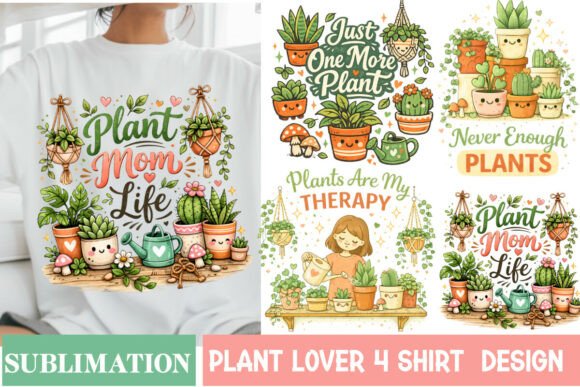
Why Plant Lover Sublimation Design,Plant Lov Is Reshaping Creative Commerce for Modern Makers
In today’s rapidly evolving creative economy, the line between passion project and professional product has blurred—not through compromise, but through precision. At the center of this shift is the Plant Lover Sublimation Design,Plant Lov: a high-fidelity, digitally native asset engineered not just for aesthetics, but for scalability, consistency, and cross-platform readiness. More than a decorative motif, it represents a new standard in purpose-built digital design—one that aligns with how creators, small-batch entrepreneurs, and print-on-demand professionals actually work today.
A Design Built for Real-World Production Demands
The Plant Lover Sublimation Design,Plant Lov isn’t merely “plant-themed.” It’s a strategic response to converging industry needs: rising consumer demand for nature-infused lifestyle products, tighter production timelines, and the growing reliance on automated, software-driven workflows. Its 300 DPI resolution, transparent PNG format, and flattened layer structure eliminate common bottlenecks—no manual background removal, no color profile guesswork, no re-rasterization before heat press or sublimation. This isn’t convenience; it’s operational efficiency encoded into a single file.
Consider a freelance merch designer launching a seasonal collection for a boutique nursery. With traditional assets, they’d spend hours adjusting contrast for mug sublimation versus cotton t-shirt DTG printing—or troubleshooting bleed issues on tote bags. The Plant Lover Sublimation Design,Plant Lov bypasses those steps entirely. Its vibrant, balanced color palette renders predictably across substrates, and its crisp vector-derived edges hold integrity whether scaled to a 2-inch sticker or a 12-inch pillow front. That reliability translates directly into faster time-to-market and fewer production rejections.
Aligning With Macro Trends in Consumer Behavior and Lifestyle Culture
Plants are no longer just décor—they’re identity markers. A 2023 McKinsey report noted that 68% of Gen Z and Millennial consumers associate indoor plant care with intentionality, mental wellness, and sustainable living. This cultural resonance has transformed botanical motifs from background elements into central storytelling devices. Tote bags emblazoned with leafy illustrations aren’t just functional—they signal values. Mugs bearing “Plant Lov” text aren’t novelty items—they’re quiet affirmations in daily ritual.
The Plant Lover Sublimation Design,Plant Lov taps into this meaning-making function without leaning on cliché. Its clean lines, balanced negative space, and intentional color saturation avoid visual fatigue—a critical advantage in an attention economy where scroll-stopping clarity determines engagement. Unlike over-saturated clipart or overly minimalist line drawings, it occupies a sweet spot: expressive enough to resonate emotionally, structured enough to scale professionally.
Technology as an Enabler—Not a Replacement—for Human Creativity
The note “🤖 Design made by Advance AI tools” isn’t a disclaimer—it’s a signal of evolution. Today’s most effective digital assets are co-created: AI handles precision scaling, color harmonization, and format optimization, while human designers define intent, context, and emotional tone. The Plant Lover Sublimation Design,Plant Lov exemplifies this synergy. Its sharp edge quality and consistent 300 DPI output reflect algorithmic rigor; its warmth, organic rhythm, and subtle asymmetry reflect deliberate artistic judgment.
This hybrid approach is becoming non-negotiable. Platforms like Cricut Design Space and Silhouette Studio now integrate AI-assisted alignment and substrate-specific preview modes. Canva’s brand kits auto-adjust palettes for print vs. screen. Adobe Photoshop’s Neural Filters streamline background isolation—but only when the source file starts clean. The Plant Lover Sublimation Design,Plant Lov meets these tools at their highest point of leverage: it’s not fighting the software; it’s optimized to thrive within it.
Practical Integration Across Business Models
For solopreneurs running Etsy shops or Shopify stores, the value proposition is immediate:
- Speed to market: Upload the PNG directly to Printful or Gelato—no prepress team needed.
- Consistent branding: Use the same file across mugs (sublimation), shirts (DTG), and greeting cards (offset print), maintaining tonal cohesion without redesign.
- Low-risk experimentation: Test new SKUs—like plant-themed stickers or printable wall art—without upfront inventory costs.
For marketing teams at eco-conscious brands, the design serves dual utility: as a ready-made campaign asset for social media banners and email headers, and as a customizable base for co-branded merchandise. Its transparent background allows seamless layering over lifestyle photography; its flattened structure ensures CMS compatibility without rendering errors.
Shifting Expectations in Quality, Compatibility, and Ownership
Five years ago, “print-ready” often meant “will probably work if you tweak it.” Today, creators expect plug-and-play fidelity. They assume compatibility—not hope for it. The explicit listing of supported platforms—Cricut Design Space, Silhouette Studio, Canva, Adobe Photoshop, Procreate—isn’t marketing fluff. It’s a direct response to documented pain points: SVG files that fail in web-based editors, layered PSDs that crash on mobile apps, or RGB-to-CMYK conversions that mute greens. The Plant Lover Sublimation Design,Plant Lov sidesteps those failures by delivering exactly what each ecosystem requires: a single, high-res, transparent PNG.
Equally important is the transparency around limitations. Stating “DIGITAL DOWNLOAD ONLY — No physical item will be shipped” and “PNG ONLY, not a cut file” manages expectations proactively. In an era where subscription fatigue and digital clutter are real concerns, clarity builds trust. Buyers know precisely what they’re licensing—and what they’re empowered to do with it.
Color Integrity in a Variable World
The note “🎨 Colors may vary slightly due to monitor printer settings” isn’t a caveat—it’s responsible disclosure. As ICC profiles become more nuanced and substrate-specific inks gain adoption (e.g., sublimation dyes for polyester vs. reactive inks for cotton), absolute color matching is increasingly contextual. What matters is *predictable variance*: the design’s palette is calibrated to retain botanical authenticity across devices and outputs. Greens stay lively, not muddy; teals remain crisp, not washed out. That consistency—grounded in color science, not guesswork—is what enables confidence in bulk orders and multi-channel launches.
Looking Ahead: Design as Infrastructure
The Plant Lover Sublimation Design,Plant Lov points toward a broader future—one where digital design functions less like static artwork and more like infrastructure. Like fonts or icon systems, next-generation assets will be built for interoperability first, expression second. They’ll carry embedded metadata for substrate recommendations, accessibility tags for alt-text generation, and version histories for collaborative iteration. They’ll be version-controlled, licensed modularly, and updated automatically for new device standards.
What makes this particular design noteworthy isn’t its subject matter—it’s its execution philosophy. It treats the creator not as a passive consumer of graphics, but as an active participant in a production ecosystem. It respects their time, their tools, and their business goals. In doing so, it doesn’t just meet current demand—it anticipates the next wave of creative commerce: one where speed, sustainability, and semantic clarity aren’t trade-offs, but foundational requirements.
For professionals building brands rooted in authenticity, for marketers translating lifestyle values into tangible products, and for makers turning passion into scalable output—the Plant Lover Sublimation Design,Plant Lov isn’t just another download. It’s a quietly powerful piece of the modern creative stack.