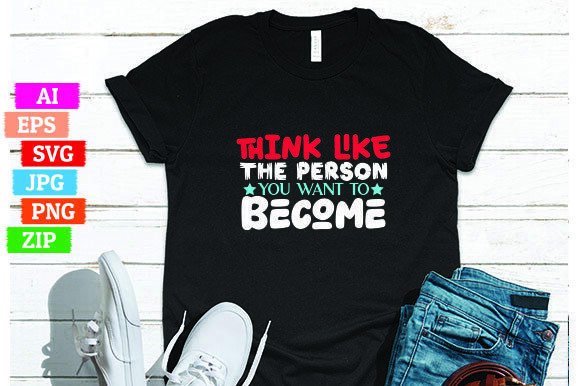
Think Like the Person You Want to Become
“Think Like the Person You Want to Become” is a motivational phrase turned design concept commonly used in print-on-demand (POD) apparel. It functions as both a mindset principle and a visual statement—intended to resonate with individuals focused on personal growth, self-improvement, or intentional identity development. In the context of POD, it refers to a ready-to-use, professionally crafted t-shirt design centered around this idea, delivered in multiple editable and production-ready file formats.
What This Design Offers—and What It Doesn’t
The design package includes an editable AI file (Adobe Illustrator), SVG (scalable vector graphics), EPS (encapsulated PostScript), PNG (raster), and transparent PNG—each optimized for different stages of the POD workflow. These files are bundled in a single ZIP folder for immediate download and use. The AI and SVG files support customization—such as resizing without quality loss, color adjustments, or integration into larger layouts. The transparent PNG allows for direct upload to most POD platforms like Printful, Teespring, or Redbubble without background removal steps.
Importantly, this is not a licensed or trademarked asset. It does not include commercial usage rights beyond standard POD distribution (i.e., printing and selling on apparel), nor does it grant rights to resell the design file itself as a digital product. Users retain full control over how and where the design is applied—but must comply with each platform’s terms of service and avoid infringing on existing trademarks or copyrighted expressions.
Why Someone Might Choose This Design
Designs like “Think Like the Person You Want to Become” appeal to creators and entrepreneurs who prioritize thematic alignment over novelty alone. They often serve audiences interested in psychology, habit formation, goal setting, or professional development—segments with consistent demand on platforms like Etsy or Amazon Merch. Because the phrase carries broad interpretive flexibility, it can be adapted across niches: students preparing for exams, career changers, fitness beginners, or mindfulness practitioners.
From a practical standpoint, the inclusion of multiple file types reduces technical friction. A user unfamiliar with vector editing can still use the transparent PNG; someone building a brand library may rely on the AI or EPS for consistency across merch lines. The design’s clean typography and minimal aesthetic also lend themselves to versatile colorways and garment placements—key considerations when testing variants on POD platforms.
Benefits and Realistic Expectations
One clear benefit is time efficiency. Sourcing, licensing, or commissioning original artwork requires research, negotiation, or design skills. This package provides a vetted, production-ready option that meets baseline quality standards for POD use. It avoids common pitfalls such as low-resolution files, non-transparent backgrounds, or unscalable raster-only assets.
However, expectations should remain grounded. While the design is high-quality, its market performance depends heavily on execution—not just the asset itself. Factors like target audience clarity, listing optimization, pricing strategy, and competitive differentiation play larger roles in long-term success than the design alone. Also, because the phrase is widely used in self-help contexts, some variation in wording or visual treatment may be necessary to stand out amid similar offerings.
Tradeoffs and Key Considerations
A primary tradeoff involves uniqueness versus familiarity. Phrases like “Think Like the Person You Want to Become” have strong recognition value, which aids discoverability—but they also carry higher saturation risk. If multiple sellers use near-identical layouts or fonts, differentiation becomes harder. Buyers may struggle to recall one version over another unless paired with distinctive styling (e.g., custom illustrations, complementary secondary text, or intentional negative space).
Another consideration is scalability. While the included vector files support resizing, the design’s visual impact may diminish on certain garment types—for example, small chest prints on youth tees or oversized back prints on hoodies—unless layout adjustments are made. Users should test mockups across intended products before launching campaigns.
Finally, compatibility with POD integrations varies. Not all platforms accept AI or EPS files directly; many require PNG uploads with specific DPI and dimension requirements. Reviewing each platform’s file guidelines before uploading helps prevent delays or rejected submissions.
When This Design Is a Strong Fit
This design suits creators who already understand their audience’s values and language. If your store focuses on growth-oriented content—such as journals, planners, or online courses—and you’re expanding into apparel, “Think Like the Person You Want to Become” aligns thematically without requiring heavy explanation. It also works well for those running targeted social media ads where messaging consistency matters more than visual novelty.
It’s also appropriate for users comfortable with basic design tools or willing to make minor edits—changing font weights, adjusting spacing, or overlaying subtle textures—to tailor the look to their brand voice. Because the files are editable, it supports iterative testing: try three versions (bold sans-serif, handwritten script, minimalist line art) and measure engagement before committing to inventory or ad spend.
When Alternatives May Be Worth Exploring
If your goal is differentiation in a crowded niche—or if your audience responds better to irony, humor, or visual metaphors—then generic motivational phrases may underperform. In those cases, custom illustration-based designs, niche-specific slogans (“Code Like the Developer You Want to Become”), or culturally resonant variations (“Lead Like the Manager You Want to Become”) could yield stronger connection and retention.
Similarly, if you plan to scale beyond t-shirts—into mugs, stickers, or wall art—consider whether the current composition translates effectively across mediums. A tightly spaced typographic layout may work on fabric but lack legibility on smaller items. In such scenarios, investing in a designer to adapt the core concept across formats may offer better long-term ROI than relying solely on the base package.
Making a Practical Decision
To determine whether “Think Like the Person You Want to Become” fits your needs, ask three questions:
- Does the phrase reflect a genuine theme in your existing or planned content? Alignment increases authenticity and simplifies cross-promotion.
- Do you have the tools or willingness to customize the files slightly? Even small tweaks—like adjusting letter spacing or adding a subtle icon—can improve distinctiveness.
- Have you reviewed search volume and competition for related terms on your chosen POD platform? Tools like eRank or MerchantWords help assess demand relative to saturation.
If the answer to at least two is yes, the design is likely a functional starting point. If not, consider using it as inspiration while developing a more tailored variation—or explore complementary concepts that match your audience’s specific aspirations and language patterns.
Ultimately, the value of any POD design lies less in its standalone quality and more in how thoughtfully it integrates into a broader strategy—audience understanding, platform requirements, and consistent messaging all shape outcomes more than file format alone.