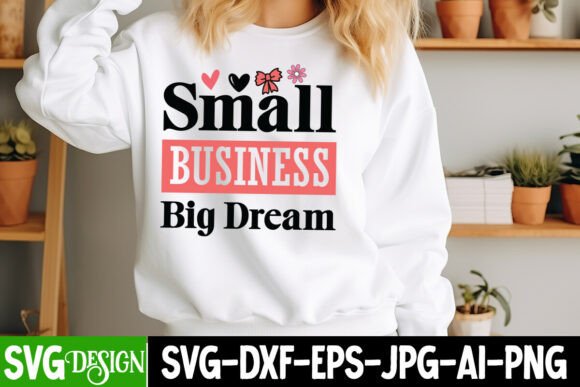
Small Business Big Dream SVG Design: A Practical Asset for Creative Entrepreneurs
For small business owners, makers, and digital product creators, the right design asset isn’t just decorative—it’s a functional tool that accelerates production, reinforces brand voice, and scales creative output without sacrificing quality. The Small Business Big Dream SVG Design fits precisely into this role: a layered, multi-format vector file built for real-world use across cutting machines, sublimation workflows, print-on-demand platforms, and digital marketing assets. It’s not a novelty—it’s infrastructure.
Where This SVG Fits in Your Creative Workflow
This design doesn’t exist in isolation. It integrates at multiple points in a typical project lifecycle—before launch, during production, and even post-launch for repurposing or merchandising. For example, before launching a new line of branded tote bags or mugs, you’d import the SVG into Cricut Design Space or Silhouette Studio to test cut settings, adjust sizing, and preview layer alignment. During production, the included EPS, AI, and DXF files let you move seamlessly between vector editors and CAD-based systems—critical if you’re collaborating with a print partner who requires editable source files. After launch, the high-res PNG and JPEG versions support social media posts, email banners, or Shopify store visuals without re-exporting or compromising clarity.
Compatibility That Saves Time, Not Creates Headaches
The bundle includes six distinct file types—SVG, EPS, PNG, DXF, AI, and JPEG—each serving a specific technical need. Unlike single-format downloads that force workarounds, this set eliminates compatibility friction. The layered SVG supports Cricut’s “cut by layer” function for multi-color vinyl projects. The EPS and AI files retain full vector scalability and editing capability in Adobe Illustrator—ideal for adjusting typography, color palettes, or spacing before sending to a professional printer. The DXF ensures precision when importing into AutoCAD or CNC software for custom signage or engraved items. And because all files are print-ready (300 DPI for raster, CMYK-optimized where applicable), there’s no last-minute resizing or color correction panic before hitting “submit” on a print order.
Using Sarcastic & Funny SVG Bundles Alongside Small Business Big Dream
The Small Business Big Dream SVG Design often works best alongside complementary bundles—especially sarcastic, witty, or personality-driven sets like the Sarcastic SVG Bundle, Funny SVG Cut Files, or Sarcastic Sublimation Bundle. These aren’t competing assets—they’re workflow partners. Imagine building a cohesive product line: your flagship mug says “Small Business Big Dream,” while your secondary designs feature “I Run On Coffee and Sarcasm” or “This Meeting Could’ve Been an Email.” Using matching file structures (layered SVGs, consistent DPI, aligned bleed areas) means switching between them takes seconds—not hours. You maintain visual consistency across products without rebuilding templates each time.
Practical Integration Tips
- Organize by use case, not format: Create folders labeled “Sublimation Ready,” “Vinyl Cut,” and “Digital Use”—then drop the appropriate file type from each bundle into its folder. This prevents grabbing a 72-DPI PNG for heat transfer paper.
- Test layers before cutting: Open the layered SVG in your machine software and verify that text, outlines, and shadow elements are grouped correctly. Some sarcastic quotes include subtle drop shadows or outlined fonts—these must be ungrouped or merged depending on your material.
- Batch-edit colors across formats: If you’re producing a set of matching stickers and mugs, edit the AI file first (changing all swatches to your brand palette), then re-export PNG and JPEG versions. Avoid editing color per file type—it invites inconsistency.
- Use the DXF for precision scaling: When adapting the design for large-format prints (like window decals or trade show banners), import the DXF into Inkscape or Illustrator and scale using absolute dimensions—not visual guesswork. Vector integrity stays intact.
Long-Term Usability and Quality Control
A well-structured SVG bundle pays dividends over time—not just in speed, but in reliability. Because the Small Business Big Dream SVG Design includes both layered and flattened versions (where applicable), you can choose simplicity or control based on the task. Need fast t-shirt transfers? Use the flattened SVG. Building a custom embroidery layout with separate thread zones? Rely on the layered version. The inclusion of source files (AI, EPS) also means you can audit paths, clean stray anchor points, or convert text to outlines—essential steps before sending to production vendors who reject live fonts.
Quality control starts with preparation. Before uploading to Printful or Gelato, open the PNG and JPEG in Photoshop and check for anti-aliasing artifacts along curved edges. If present, go back to the AI file, adjust the export settings (uncheck “Anti-alias” for crisp vinyl cuts; enable it for web display), and re-export. This step alone prevents dozens of rejected proofs down the line.
Real-World Implementation Across Roles
A freelance graphic designer might use the Small Business Big Dream SVG Design as a client-ready starting point—customizing colors and adding logos before delivering final assets. An educator creating classroom posters could combine it with the Sarcastic Quotes SVG files to build motivational yet relatable bulletin board sets. A blogger launching a merch line might pair it with the Funny Doormat SVG Bundle to create a cohesive “home office essentials” collection—each item sharing the same vector structure, spacing logic, and bleed margins.
Even if you’re not cutting or printing yourself, the file diversity matters. Platforms like Redbubble or Teespring accept SVG, PNG, and EPS uploads—and having all three on hand means you’re never scrambling to convert or compress mid-upload. No more “Oops, this PNG is 2MB and got rejected” moments.
Efficiency Without Compromise
This isn’t about doing more—it’s about removing repetition. When your SVG files are consistently structured, properly named (“small-business-big-dream-sublimation.png”, not “IMG_2948.png”), and stored with clear metadata, searching, retrieving, and reusing them becomes automatic. That efficiency compounds: one minute saved per file adds up to hours reclaimed monthly. More importantly, it reduces decision fatigue. You’re not debating which format to use—you know the PNG goes to Instagram, the SVG to Cricut, the AI to your printer.
The Small Business Big Dream SVG Design works because it respects how people actually create—not how theoretical workflows say they should. It assumes you’ll juggle deadlines, collaborate with others, switch tools mid-project, and need outputs that hold up under scrutiny. That’s why the attention to detail—from layer naming conventions to embedded color profiles—matters more than flashy descriptions. It’s built for execution, not just inspiration.