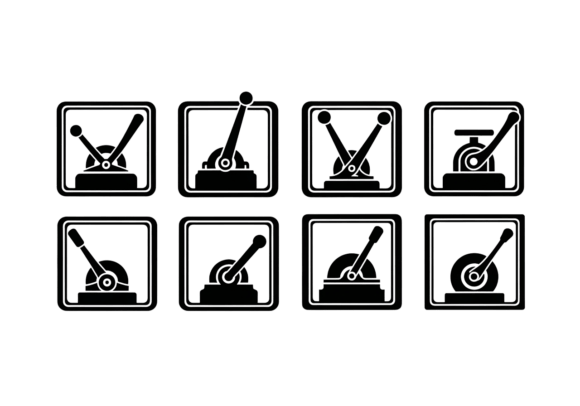
Lever Switch Icons Set Vector Graphics
Vector graphics are not just files—they’re strategic assets. The Lever Switch Icons Set Vector Graphics is a purpose-built digital cut file designed for precision, flexibility, and real-world execution. Unlike raster images or generic clipart, this set delivers clean, infinitely scalable icons rooted in industrial design language—think toggle switches, rocker levers, and momentary push controls. These aren’t decorative flourishes; they’re visual shorthand for action, control, and functionality. When applied intentionally, they strengthen messaging, clarify intent, and support brand coherence across physical and digital touchpoints.
Why This Set Fits Into Strategic Design Workflows
Most designers and makers choose vector assets for one reason: fidelity under change. The Lever Switch Icons Set Vector Graphics excels here—not because it’s “pretty,” but because it’s built to behave predictably across contexts. Its SVG, EPS, and PNG formats map directly to production needs: SVG for web and cutting software compatibility (Silhouette Designer Edition, Cricut Design Space, Sure Cuts A Lot), EPS for print-ready refinement in Adobe Illustrator or CorelDRAW, and PNG for quick mockups or layered composites where transparency matters.
This isn’t about convenience alone. It’s about reducing friction between idea and outcome. A small business owner designing custom control-panel decals for a workshop tool cart doesn’t need to redraw consistent switch shapes from scratch—or risk misalignment across batches. An educator creating interactive STEM posters can use the same lever icon across worksheets, slides, and vinyl wall displays without quality loss. That consistency compounds over time: fewer revisions, faster prototyping, more reliable output.
Where It Adds Real Value—And Where It Doesn’t
The Lever Switch Icons Set Vector Graphics delivers highest ROI when aligned with clear objectives—not aesthetics alone. Consider these grounded use cases:
- T-shirts and apparel: A maker launching a line of “maker culture” tees uses the rocker switch icon as a subtle nod to hands-on problem-solving—not as decoration, but as identity reinforcement. Paired with minimal typography, it signals expertise without explanation.
- Vinyl decals for equipment: A technician labels calibration tools with tactile, high-contrast lever icons. Because the SVG retains crisp edges at any size, even 0.5-inch decals remain legible on stainless steel surfaces under workshop lighting.
- Home décor and wall art: An interior designer incorporates the toggle switch motif into a modern-industrial gallery wall. Scaling the EPS version ensures seamless alignment across multiple framed prints—no pixelation, no reworking.
- Scrapbooking and educational kits: A homeschool parent cuts lever-shaped paper pieces from cardstock using the SVG file. The clean paths prevent jagged edges on intricate cuts, supporting fine motor skill development through precise, repeatable shapes.
Conversely, the set offers little strategic value if used without intention—for example, dropping a lever icon onto a coffee mug simply because it’s available. Without context, it confuses rather than communicates. A lever implies interaction, activation, or choice. If your product or message doesn’t involve those concepts, the icon dilutes clarity instead of enhancing it.
Planning Your Use—Before You Import the File
Before opening the SVG in your cutting software or dragging the EPS into Illustrator, ask three questions:
- What action or concept does this icon represent in my project? Is it literal (a physical switch on a device) or metaphorical (a “switch” in mindset, workflow, or user behavior)? Clarity here prevents mismatched symbolism.
- At what scale and medium will it appear? A 3-inch vinyl decal on a toolbox requires different stroke weight and spacing considerations than a 16-pixel icon in a digital interface mockup. Review the original vector paths—you can adjust anchor points, simplify nodes, or add subtle shadows *before* final export.
- How does it relate to other visual elements? Does it harmonize with your existing color palette? Does its line weight match other icons or typography in the layout? Consistency in visual hierarchy strengthens recognition and trust.
These aren’t theoretical exercises. They’re filters that separate functional design from decorative noise. The Lever Switch Icons Set Vector Graphics gives you the raw material—but your decisions determine whether it supports understanding or distracts from it.
Risks of Using Without Context
Using vector assets without grounding them in purpose carries quiet but measurable costs:
- Brand dilution: Repeating a lever icon across unrelated products (e.g., yoga mats and circuit boards) without narrative linkage weakens brand meaning. Symbols gain power through repetition *with coherence*, not repetition alone.
- Production delays: Assuming all formats behave identically can backfire. An EPS file may render perfectly in Illustrator but throw scaling errors in older versions of Inkscape. Always test your target software *before* committing to large runs.
- Misaligned audience perception: A technical audience reads a lever icon as functional precision; a general consumer might read it as “industrial” or “cold.” If your goal is approachability—not authority—this symbol may work against you unless paired with warmer supporting elements (color, texture, phrasing).
None of these risks stem from the file itself. They arise from skipping the step of asking *why* before *how*.
Long-Term Utility: Beyond the First Project
A well-chosen vector set compounds value over time. The Lever Switch Icons Set Vector Graphics becomes more useful the more you understand its structure—not just its appearance. Study the layer organization in the SVG. Notice how stroke widths are optimized for cutting versus screen display. Observe how anchor points are placed for smooth scaling. That knowledge lets you adapt the icons—not just resize them.
For example, a freelance graphic designer might extract individual lever components (base, actuator, housing) to build custom composite icons for client dashboards. A small-batch manufacturer could modify the EPS file to include registration marks for multi-layer vinyl application. An educator might convert the SVG into an animated SVG for interactive e-learning modules—lever movement triggering explanatory text.
This kind of reuse isn’t possible with low-resolution PNGs or unstructured vectors. It relies on clean construction—and the intentionality to treat the file as a tool, not a shortcut.
Making It Work for Your Goals
If you’re evaluating whether the Lever Switch Icons Set Vector Graphics fits your needs, start small—but think systemically. Run one test: import the SVG into your primary cutting software, scale it to your most common decal size, and run a test cut on your preferred material. Note where paths hold cleanly and where adjustments improve edge definition. Then ask: does this align with how I want users to interpret my work? Does it simplify a process—or add complexity?
That test reveals more than compatibility. It reveals fit. And fit—not features—is what determines long-term usefulness. Whether you're launching a product line, building classroom resources, or refining your studio’s visual language, the right vector asset doesn’t just save time. It reinforces decision-making discipline, supports consistent execution, and quietly elevates the credibility of everything it touches.
The Lever Switch Icons Set Vector Graphics is ready. What you do with it—and why—is where strategy begins.