FREE Sketch Bo Staff Icon
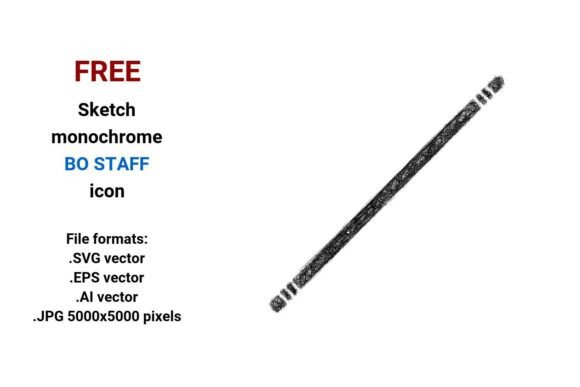
The FREE Sketch Bo Staff Icon is a hand-drawn, black-and-white vector illustration of a traditional martial arts long staff—commonly known as a bo staff, bostaff, or wooden staff. It’s delivered in four widely compatible file formats: .SVG, .EPS, .AI, and high-resolution .JPG (5000×5000 pixels). Designed with minimalism and clarity in mind, the icon features clean strokes, subtle sketchy texture, and deliberate curves—evoking a handdrawn, freehand aesthetic while maintaining precision for digital use.
Why Consider This Icon?
Designers, educators, app developers, and martial arts practitioners often seek visual assets that communicate function, tradition, and simplicity. The FREE Sketch Bo Staff Icon meets this need where symbolic clarity matters more than photorealism. Its black-and-white, line-based style supports accessibility, scalability, and integration into diverse interfaces—from UI kits and training apps to educational websites and print materials.
Because it’s a vector image, the icon is built from mathematical paths rather than pixels. This means it retains sharpness at any size—whether scaled down to 24×24 pixels for a mobile app button or enlarged to poster size for a dojo wall graphic. Unlike raster images, vectors avoid pixelation, blurring, or loss of fidelity when resized.
Key Benefits
- Format flexibility: With .SVG (web-optimized), .EPS and .AI (print and professional design workflows), and .JPG (universal compatibility), users can deploy the icon across platforms without conversion risk.
- Adaptability in context: Its sketchy, minimal stroke style works well in wireframes, UI mockups, icon sets, and instructional diagrams—especially where a “handmade” or approachable tone is appropriate.
- No licensing cost or attribution requirement: As a truly free resource, it lowers barriers for students, small studios, or non-commercial projects needing a recognizable martial arts symbol.
- Thematic alignment: Keywords like bo staff icon, wooden staff icon, long staff icon, and martial arts vector reflect its functional scope—making it discoverable for users seeking precise visual metaphors.
Tradeoffs and Considerations
While versatile, the FREE Sketch Bo Staff Icon is intentionally stylized—not detailed or realistic. It does not depict grip tape, grain texture, or dimensional shading. Users requiring photorealistic rendering, color variants, or multiple poses (e.g., staff in motion) will find it insufficient on its own.
The sketchy line quality—though expressive—may not suit formal branding systems that prioritize geometric precision or corporate neutrality. Similarly, because it’s monochrome, it doesn’t support color-coded categorization (e.g., differentiating staff types by hue) without manual editing.
Also note: While the .JPG version is high-resolution, it remains a raster file. For applications demanding infinite scalability—like large-format signage or responsive web icons—the vector formats (.SVG, .EPS, .AI) are essential. Relying solely on the .JPG limits future adaptability.
When It’s a Strong Fit
This icon excels in scenarios where conceptual clarity, scalability, and stylistic cohesion outweigh the need for realism or customization. Examples include:
- Educational tools: Martial arts curriculum sites, beginner guides, or interactive learning modules benefit from its clear, uncluttered representation of a bo or long staff.
- UI/UX prototyping: Designers building fitness, self-defense, or wellness apps may use it as a bo staff button or navigation symbol—especially in early-stage sketches or low-fidelity wireframes.
- Printed resources: Brochures, posters, or handouts for community dojos or workshops gain visual consistency using a scalable, legible wooden staff icon.
- Icon libraries: Developers curating minimalist, handdrawn vector icon sets can integrate it alongside other sketch symbol assets—enhancing thematic unity across categories like sports, tools, or disciplines.
When to Explore Alternatives
Consider other options if your project requires:
- Color or transparency control beyond black-and-white: Some vector icons offer layered color swatches or alpha channels; this one does not.
- Multiple angles or action-oriented depictions: A static front-facing outline won’t convey dynamic use—so motion-based illustrations or animated SVGs may be preferable for tutorials or demonstrations.
- Brand-specific styling: If your visual identity relies on custom stroke weight, rounded corners, or integrated typography, you may need to modify the icon—or commission a bespoke handdrawn vector icon aligned to your guidelines.
- Technical documentation or engineering contexts: Where accuracy in proportion, material notation, or dimensional annotation matters, a schematic or CAD-style diagram would serve better than a stylized line bo staff icon.
Making an Informed Choice
Before downloading or integrating the FREE Sketch Bo Staff Icon, ask yourself:
- What’s the primary use case? If it’s for interface elements, teaching aids, or scalable print, the icon’s strengths align well. If it’s for product packaging, marketing banners, or technical specs, evaluate whether its minimalism supports your goals.
- Do you have access to vector-editing tools? To fully leverage .SVG, .EPS, or .AI files, basic familiarity with software like Adobe Illustrator, Affinity Designer, or Figma is helpful—even simple recoloring or resizing benefits from vector awareness.
- Is consistency with other assets important? Review your existing icon set. Does the sketchy, freehand quality complement—or clash with—other symbols? A mismatch in line weight, density, or tone can undermine visual hierarchy.
- What’s your timeline and technical capacity? Because it’s free and ready-to-use, it reduces production time—but only if it fits your constraints. Customizing it significantly may take longer than sourcing a closer match.
In summary, the FREE Sketch Bo Staff Icon is a practical, accessible asset for communicative clarity—not visual complexity. It serves best when the goal is recognition, not realism; simplicity, not specificity. For users evaluating martial arts-related visual resources, it offers reliable utility across education, interface design, and community outreach—provided expectations around style, scalability, and adaptability are grounded in its actual capabilities.