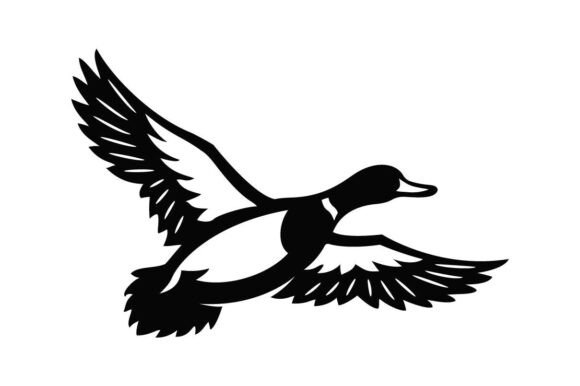
Flying Mallard Duck SVG
There’s something timeless about the silhouette of a mallard in flight — wings angled just so, body streamlined, tail feathers fanned with quiet precision. The Flying Mallard Duck SVG captures that moment with clean, confident linework and balanced negative space. It’s not an illustrated scene or a cartoonish duck; it’s a refined vector interpretation — purposeful, scalable, and built for real-world making. Whether you’re etching it into cedar for a lodge sign or layering it onto a camo truck decal, this design carries the quiet authority of wildlife observed closely and rendered thoughtfully.
A Design That Works Where You Work
This isn’t a decorative flourish meant only for Pinterest boards. The Flying Mallard Duck SVG is engineered for function across mediums and intentions. Its outlines are optimized for cutting — no fragile interior details that snag on vinyl weeding tools or laser kerf. Curves are smooth but not overly complex, ensuring reliable performance on Cricut Explore and Silhouette Cameo machines. At small sizes (think 1.5-inch apparel patches), it retains legibility. At large scales (36-inch wood wall art), it holds its shape without pixelation or distortion — thanks to true vector geometry in the SVG and EPS files.
The included PNG version — 300 DPI with transparent background — works cleanly over textured substrates: distressed barn wood, kraft paper invites, or matte-finish apparel mockups. And because the DXF file is natively supported by Silhouette Studio, users who rely on that platform don’t need converters or workarounds to get precise cut lines.
More Than a Duck — A Visual Anchor for Identity
In branding and craft contexts, a single strong motif can do heavy lifting. The Flying Mallard Duck SVG functions as a visual anchor — recognizable at a glance, evocative without being literal. For a hunting outfitter launching branded gear, it signals authenticity and regional familiarity. For a nature-focused wedding planner, it adds subtle thematic cohesion to table numbers or aisle markers — elegant but grounded, not cutesy. Even in editorial contexts like a regional outdoor magazine’s cover feature on wetland conservation, it serves as a quiet, dignified emblem.
What makes it effective isn’t just accuracy — it’s restraint. There’s no exaggerated beak, no comical waddle implied in the pose. Instead, the upward tilt of the wings suggests motion and intention. That kind of subtlety builds trust. Viewers read competence, not clipart. That perception matters whether you’re selling engraved metal dog tags or designing signage for a wildlife refuge visitor center.
Practical Pairings and Real-World Fit Checks
Before committing to any design asset — especially one used across multiple products — test how it behaves in your actual workflow. With the Flying Mallard Duck SVG, start simple: import the SVG into your cutting software and run a test cut on scrap material. Check how the wingtips and tail feather separation hold up at your intended size. If you’re using it for engraving, preview the vector paths in your laser control panel — look for overlapping nodes or unintended joins that could cause double-burns.
For font pairing, lean into contrast. This duck reads best beside typefaces with clarity and structure — think a sturdy sans serif like Montserrat or a warm, low-contrast serif like Lora. Avoid competing scripts or tightly spaced display fonts that compete for attention. On apparel, set the duck alone or with minimal text (e.g., “Blackwater Creek Outfitters” in all caps, 10 pt tracking). In wood signs, let it breathe — mount it centered on a 12×16 pine board with no text at all. Its strength is in its silence.
Also consider context-driven color. The SVG itself has no built-in fill — it’s a path, not a colored shape — so you choose. Olive drab for tactical gear, deep teal for lake-themed weddings, raw brass tone for engraved metal. That flexibility is intentional. It means the same file adapts without needing recoloring or editing — just a fill swatch change in your software.
Licensing That Supports Real Creative Work
This isn’t a free download with murky terms. The Flying Mallard Duck SVG comes with straightforward commercial licensing: use it on physical products you sell — t-shirts, hats, engraved tumblers, cabin signs — no royalties, no limits on quantity. You can embed it in digital templates you sell (e.g., Canva-compatible wedding kits), provided the SVG itself isn’t delivered as a standalone, editable file to the end buyer. That protects both you and the designer — clear boundaries, no guesswork.
What’s excluded? Reselling the SVG files themselves, uploading them to font marketplaces, or claiming copyright over the vector artwork. But those restrictions align with standard industry practice — and they’re far less limiting than what many hobbyist designers encounter with free resources that prohibit *any* commercial use.
Final Notes From the Workshop Bench
If you’ve ever spent hours tracing a raster image only to find the curves won’t cut cleanly — or tried scaling a PNG until it turned fuzzy — you’ll appreciate how much time this SVG saves. It’s not flashy. It doesn’t come with 12 weight variants or animated versions. It does one thing well: deliver a single, field-ready mallard in flight — technically sound, visually cohesive, and quietly versatile.
Use it where authenticity matters more than ornament. Where craftsmanship meets intention. Where the right detail — a wing’s angle, a tail’s taper — says more than ten words could.