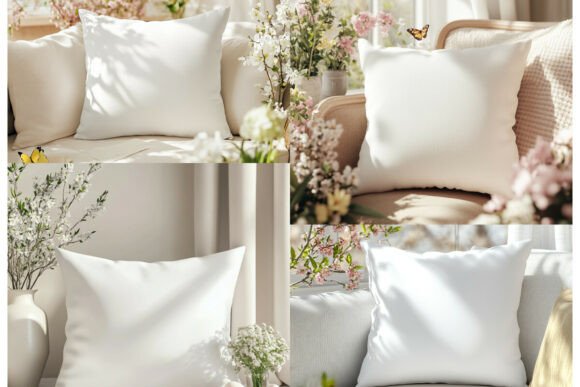
Easter Day Pillow Mockup & White Pillow Mockup
Imagine launching your Easter collection with visuals so vivid and authentic that customers instantly picture your pillow on their sofa—or gifting it to a loved one. That’s the quiet power of a well-chosen Pillow Mockup, Easter Day Pillow Mockup, especially when paired with a clean, AI-crafted White Pillow Mockup. These aren’t just placeholders—they’re presentation tools designed to bridge the gap between concept and customer confidence.
Why realistic mockups matter more than you think
A digital design alone rarely conveys texture, drape, or scale. When you share a flat JPEG of your Easter bunny pattern or hand-lettered “He Is Risen” quote, viewers mentally fill in the blanks—often inaccurately. A high-fidelity Pillow Mockup, Easter Day Pillow Mockup solves that by embedding your artwork into a photorealistic context: soft fabric folds, subtle shadow gradients, natural light catching the edge of the cushion. This isn’t about polish for polish’s sake—it’s about reducing cognitive load for your audience. Shoppers, clients, or collaborators can assess proportion, color harmony, and overall vibe in under three seconds.
Time saved is creativity earned
Photographing physical samples eats hours—scheduling studio time, styling props, adjusting lighting, editing shots. For seasonal collections like Easter, timing is tight. With this White Pillow Mockup, you skip that entire workflow. Drop your design into the smart object layer in Photoshop, or upload to Canva using the included PNG files, and render a professional preview in under two minutes. One designer preparing 12 Easter-themed pillows for her Etsy shop reported cutting mockup prep from 6 hours to 45 minutes—time she redirected toward refining embroidery details and writing product stories.
Consistency builds trust across platforms
Your Instagram grid, Shopify product page, Pinterest pin, and email campaign all benefit from visual continuity. Using the same Pillow Mockup, Easter Day Pillow Mockup template across touchpoints creates subconscious cohesion. Customers recognize your brand’s aesthetic not just through color or font—but through how your designs inhabit space. The uniform lighting, angle, and fabric tone in this mockup mean your Easter floral print and minimalist scripture quote feel like part of the same thoughtful collection—not unrelated experiments.
Who benefits most—and how
- Small business owners selling sublimation-printed throw pillows use the 300 DPI PNGs to generate crisp Amazon thumbnails and Etsy banners—no pixelation at zoom, no need for expensive retouching.
- Educators and bloggers creating Easter craft tutorials embed the White Pillow Mockup to show learners exactly how their hand-drawn motifs translate to fabric—before they cut a single piece of vinyl.
- Freelance designers pitching to home decor brands present concepts with realism, not guesswork. One client shared that using this mockup helped her win a contract because the brand lead said, “Finally, I can see how this will look *in real life*.”
- Hobbyists launching side projects avoid the pressure of perfect photography. Their first batch of Easter pillows gains credibility without investing in gear or skills they haven’t yet built.
What makes this White Pillow Mockup stand out
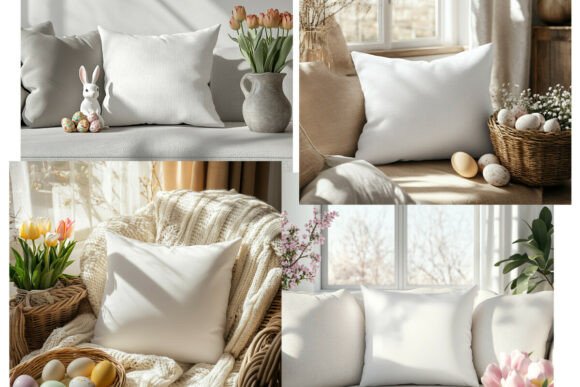
Not all white pillow mockups are equal. This one avoids the “floating canvas” effect—where designs appear pasted onto a flat surface instead of woven into fabric. Its realistic texture simulates tightly woven cotton-linen blend, with gentle creases and soft highlights that respond naturally to your design’s contrast and saturation. The lighting is neutral and diffused (no harsh studio glare), making it equally effective for pastel Easter palettes and bold typography. And because it ships as four distinct PNG angles—front, slight 3/4, top-down, and angled side—you’re covered whether you’re building a carousel post or a multi-view product gallery.
Realistic expectations: where it shines (and where to pause)
This Pillow Mockup, Easter Day Pillow Mockup excels when your goal is clarity, speed, and consistency for standard 18″×18″ square throw pillows. It’s ideal for screen printing, sublimation, and digital textile applications. However, if you’re designing for oversized floor cushions, velvet textures, or irregular shapes (like lumbar or bolster pillows), you’ll want to seek specialized variants. Likewise, while the AI-assisted base ensures strong realism, fine-tuning shadows or fabric stretch for ultra-complex patterns may still require light manual adjustment in Photoshop—especially with heavy metallic foils or intricate lace overlays.
Getting started—simple, not simplistic
You don’t need advanced design training. Open the PNG in Canva, click “Edit image,” then “Upload image” over the pillow area. Resize your artwork to fit the visible surface, adjust opacity if needed for subtle watermarking, and download. In Photoshop, double-click the smart object layer, paste your design, save, and watch it auto-update in context. All four views include transparent backgrounds, so you can drop them cleanly onto lifestyle scenes, mood boards, or social templates without clipping masks.
Beyond Easter: designing with longevity in mind
Though labeled an Easter Day Pillow Mockup, its minimal white base and neutral lighting make it adaptable year-round. Swap in spring florals, summer quotes, autumn harvest motifs, or holiday typography—the structure stays relevant. One small publisher uses it to preview seasonal journal covers adapted as pillow art; another repurposes the same mockup for client presentations across interior design, wedding stationery, and faith-based merchandise. The value isn’t just in the Easter label—it’s in the flexibility baked into the design system itself.
A final note on authenticity
Mockups serve best when they support honesty—not replace it. Use this White Pillow Mockup to clarify intent, demonstrate craftsmanship, and invite meaningful feedback. If your actual pillow uses a different fabric weight or stitch density, mention that alongside your mockup. Transparency builds deeper trust than perfection ever could. And when your first real order arrives? Photograph it. Let that photo sit beside your mockup in your portfolio—not as a correction, but as a quiet testament to the journey from idea to object.