American Stars on Leather Pattern: A Practical Guide for Crafters and Designers
When selecting digital papers for creative projects, texture, theme, and versatility matter—especially for designs rooted in American symbolism. The American Stars on Leather Pattern stands out as a cohesive, high-fidelity resource that merges patriotic motifs with tactile realism. Unlike flat vector stars or generic red-and-blue gradients, this pattern simulates the subtle grain, soft sheen, and dimensional depth of real leather—while overlaying crisp, evenly spaced five-point stars. It’s not just “stars on a background”; it’s stars embedded in material, lending warmth and authenticity to printed and digital applications.
What Makes This Pattern Distinctive?
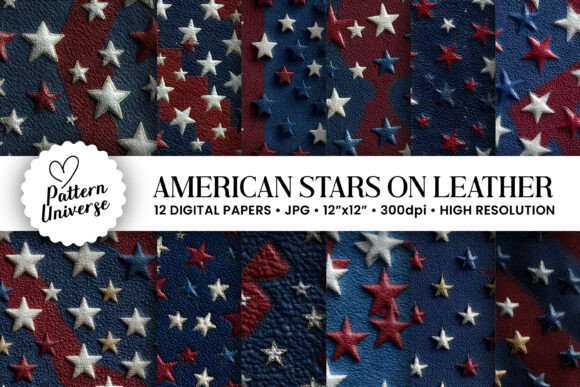
The American Stars on Leather Pattern is built around two deliberate design decisions: material fidelity and seamless scalability. Each of the 12 included papers uses photorealistic leather textures—some lightly distressed, others smoother and more refined—but all maintain consistent star density, proportion, and alignment across repeats. Because the pattern is truly seamless, it tiles without visible breaks at any scale—critical for large-format prints like wall art or tumbler wraps where misaligned edges would undermine professionalism.
At 3600 × 3600 pixels (12″ × 12″) and 300 DPI, these files meet commercial print standards without upsampling or interpolation. That resolution supports sharp detail even when zoomed or cropped—for example, isolating a single star-and-leather segment for a greeting card border or scaling the full tile to cover a 24″ × 36″ scrapbook layout. Importantly, the leather tone stays neutral: warm but not overly brown, muted but not desaturated—so it pairs reliably with navy, burgundy, cream, charcoal, or metallic foil accents.
How It Compares to Other Patriotic or Textured Digital Papers
Digital paper libraries often include patriotic themes, but they fall into three broad categories: illustrative (hand-drawn or stylized stars), photographic (scanned fabric or paper swatches), and procedural (algorithmically generated repeats). The American Stars on Leather Pattern sits at the intersection of photographic realism and procedural precision—it avoids the flatness of clipart-style stars while retaining the consistency and editability of a designed repeat.
Compared to scanned leather textures alone, this pattern adds intentional symbolic layering—not just background, but meaning. Compared to watercolor or linen-textured star patterns, it offers greater contrast and legibility, especially for small-scale applications like journal tags or envelope liners. And unlike many AI-generated patterns that prioritize novelty over usability, this set prioritizes functional harmony: stars are spaced to avoid visual clutter, leather grain doesn’t compete with star outlines, and color values remain printer-friendly across CMYK and RGB workflows.
Strengths Across Common Craft Use Cases
Here’s where the American Stars on Leather Pattern delivers tangible value:
- Gift wrapping & packaging: The leather texture adds perceived luxury; stars read clearly even on matte or kraft paper stock. Unlike glossy foil patterns, it reproduces well on home printers and local print shops.
- Greeting cards & invitations: Works equally well for formal military appreciation events and casual July 4th gatherings. The neutral base allows easy pairing with typography—serif fonts gain gravitas; clean sans-serifs feel modern and inclusive.
- Tumbler wraps & vinyl decals: Seamless tiling means no awkward seams when wrapped around cylindrical surfaces. The 12″ × 12″ dimension fits standard cutting machine mats (Cricut, Silhouette) without scaling distortion.
- Junk journal & scrapbook backgrounds: Offers enough visual interest to serve as a foundation, yet enough subtlety to keep focus on photos, ephemera, or handwritten notes. Grain direction varies slightly across the 12 papers—giving variety without inconsistency.
- Wall art & printable decor: At 300 DPI, it holds up well when enlarged to poster size (e.g., 24″ × 36″ via interpolation-free scaling in Adobe Photoshop or Affinity Photo).
Tradeoffs and Realistic Limitations
No digital paper excels in every context—and understanding its boundaries helps avoid mismatched expectations. The American Stars on Leather Pattern is intentionally restrained in color: it does not include high-contrast red/white/blue variants, nor does it offer distressed, weathered, or vintage-filtered versions. If your project demands bold chromatic contrast (e.g., a children’s birthday theme), you may need to layer or recolor manually—or choose a different base pattern.
It also assumes a preference for organic texture over geometric precision. Those seeking perfectly symmetrical, grid-aligned stars (like architectural blueprints or tech-inspired designs) may find the leather grain too soft or irregular. Similarly, users needing transparent PNGs for layered digital collages will need to extract the pattern manually—these are JPEGs optimized for print, not web-native overlays.
Finally, while AI-assisted generation enabled rapid iteration and consistency across the 12 papers, it doesn’t replace human curation. The set was reviewed for repeat integrity, star clarity, and tonal balance—but it won’t adapt dynamically to your specific brand palette or layout constraints. Some customization (e.g., hue adjustment, contrast tweaking) remains necessary for tight brand alignment.
When This Pattern Is Likely the Right Choice
Consider the American Stars on Leather Pattern if you’re working on projects that benefit from grounded, tactile patriotism—where symbolism feels earned, not decorative. It suits makers who value both aesthetic cohesion and technical reliability: someone designing a veteran tribute album, printing custom mugs for a community center fundraiser, or assembling a cohesive suite of wedding stationery with subtle national pride elements.
It’s also practical for time-constrained creators. Because all 12 papers share the same underlying structure, swapping one for another mid-project maintains visual continuity—no reworking layouts or adjusting spacing. And since they’re delivered in a single ZIP file with standardized naming (e.g., StarsOnLeather_01.jpg through _12.jpg), organization and version control stay simple.
When You Might Explore Alternatives
If your work leans heavily into historical accuracy—say, replicating 18th-century flag motifs or Civil War-era document textures—the American Stars on Leather Pattern may feel too contemporary in grain and spacing. Likewise, if you’re building a fully branded system (e.g., a nonprofit’s annual report with strict Pantone requirements), you’ll likely need custom-designed assets rather than off-the-shelf digital papers.
For digital-only use—such as social media templates or Canva-based presentations—smaller file sizes or SVG-based scalable stars might be more efficient than high-res JPEGs. And if you regularly work with textured overlays in Procreate or Photoshop, you may prefer individual leather and star layers (not combined) to retain maximum editing flexibility.
Making an Informed Decision
Choosing digital paper isn’t just about aesthetics—it’s about workflow compatibility, output fidelity, and long-term reuse potential. The American Stars on Leather Pattern succeeds where many similar resources don’t: by balancing symbolic resonance with technical rigor. Its 12-paper range gives variety without fragmentation; its resolution and seamlessness support both craft-scale and small-business production needs; and its leather-star synthesis avoids cliché while honoring tradition.
That said, the best choice depends on your specific goals, tools, timeline, and audience. If you’re evaluating options, ask yourself: Does this pattern simplify or complicate my current process? Will it hold up across my intended outputs—from printed cards to large wall prints? Does its tone align with how I want viewers to feel—respectful, celebratory, nostalgic, or modern? Answering those questions honestly matters more than any single feature list.