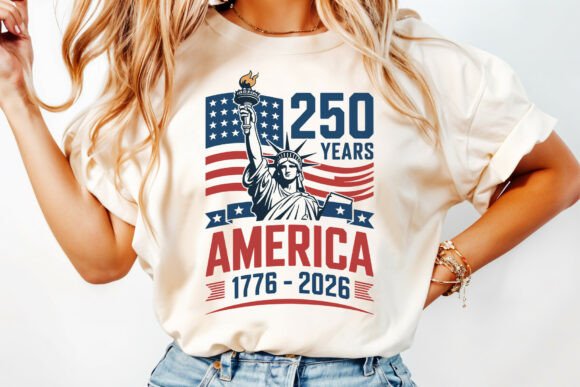
250th Anniversary T-Shirt Design
A 250th Anniversary T-Shirt Design is a digital artwork file created specifically for commemorative use—typically to mark a significant institutional, organizational, or community milestone. Unlike mass-produced apparel, this design is delivered as a ready-to-use digital asset in multiple high-resolution formats: EPS (vector, scalable without quality loss), PNG at 300 dpi (4500×5400 pixels, ideal for print), and JPG (widely compatible for quick previews or web use). It is not a physical garment but a versatile graphic intended for application across a range of personal and promotional items.
People seek a 250th Anniversary T-Shirt Design for several practical reasons. Some are organizing local events, reunions, or heritage celebrations and need cohesive visual branding. Others represent schools, towns, historical societies, or long-standing businesses that have reached this rare milestone and wish to create meaningful keepsakes. The design often includes thoughtful elements—such as symbolic motifs (e.g., laurel wreaths, colonial typography, or timeline graphics), historically resonant color palettes, and concise, respectful quotes—that reflect gravity and continuity without relying on cliché.
One key benefit is flexibility. Because the files include vector (EPS) and high-resolution raster (PNG) formats, users can scale the design for different applications without degradation: printing on adult and youth t-shirts, transferring onto mugs or tote bags, adapting for framed wall art, or incorporating into printed invitations and signage. The inclusion of both PNG and JPG ensures compatibility with common design software and online print-on-demand platforms. This makes the 250th Anniversary T-Shirt Design especially useful for individuals managing small-batch production themselves—or coordinating with local printers who require specific file types.
However, there are tradeoffs to consider. As a digital-only product, it does not include printing services, fabric recommendations, or sizing guidance. Users must independently verify color accuracy across devices and printers, particularly when matching historical palettes. The design is also pre-made—not custom—and while it includes carefully selected visual language, it may not reflect hyper-local details (e.g., a specific town seal, founding date formatting preferences, or bilingual text). Adjustments would require access to vector-editing software and basic design knowledge, or collaboration with a designer.
Expectations should be grounded in the product’s scope. You receive three file types, each serving a distinct purpose: EPS for infinite scalability and professional print workflows; PNG for crisp, transparent-background output suitable for DTG (direct-to-garment) printing; and JPG for easy sharing or mockup previews. No fonts are embedded in the EPS unless explicitly stated, so substitution may be needed if editing text. Likewise, no trademarked symbols or licensed imagery are included—ensuring broad usability while avoiding legal complications.
A 250th Anniversary T-Shirt Design is a strong fit when you need consistency, efficiency, and dignity across multiple physical outputs—and when your timeline or budget doesn’t allow for commissioning original artwork. It suits organizers preparing for anniversary galas, museum gift shops curating commemorative merchandise, or families commemorating multi-generational legacies. It works well if your audience values tradition and subtlety over trend-driven aesthetics, and if you already have access to reliable printing resources or familiarity with upload requirements for platforms like Printful or Gelato.
Alternatives may be preferable in certain cases. If your event requires strict adherence to an official logo system, branded guidelines, or multilingual support, a commissioned design from a graphic designer offers tailored control. Similarly, if you’re producing large quantities and need vendor-ready files with Pantone color specifications or layered print separations, a specialist may provide more precise deliverables. For informal, low-stakes gatherings—such as backyard reunions where thematic cohesion matters less than affordability—a simpler, editable template from a design platform might suffice. And if the focus is purely digital (e.g., social media banners or email headers), lower-resolution assets could meet the need without requiring 300 dpi files.
Practical decision-making starts with clarifying your primary use case. Ask: Will this design appear mainly on apparel, or across diverse surfaces like ceramics, paper, and walls? Do you need full editing capability—or is finality acceptable? What level of historical specificity is required? If your answer points toward broad applicability, moderate customization needs, and reliance on standard print workflows, the 250th Anniversary T-Shirt Design aligns well. If instead you require granular control over typography, iconography, or cultural nuance—or lack confidence adjusting vector files—the investment in a custom solution may yield better long-term utility.
Also consider technical readiness. Can you open and export EPS files using software such as Adobe Illustrator, Affinity Designer, or Inkscape? Do you know how to convert a PNG to a print-ready PDF with bleed and crop marks? If not, allocate time to learn or enlist help—because while the files are professionally prepared, their effective use depends on your workflow. Reviewing sample mockups (if provided) helps assess real-world legibility at typical shirt sizes—especially for smaller text elements or fine-line details that may blur when scaled down.
Finally, think about longevity. A well-executed 250th Anniversary T-Shirt Design serves beyond the celebration itself: it becomes archival material, a reference for future milestones, or part of a documented heritage initiative. Its value increases when treated as a foundational asset—not just a one-off decoration. That means storing files securely, documenting usage rights (which, in this case, typically permit personal and non-commercial use, with limitations on resale of unaltered designs), and retaining source files for future adaptation.
In summary, the 250th Anniversary T-Shirt Design is a functional, adaptable resource suited to those balancing authenticity, practicality, and efficiency. It supports commemoration without demanding design expertise—but does require clarity about goals, technical capacity, and intended applications. Evaluating it against your specific context—not just its features—leads to a more informed choice.